
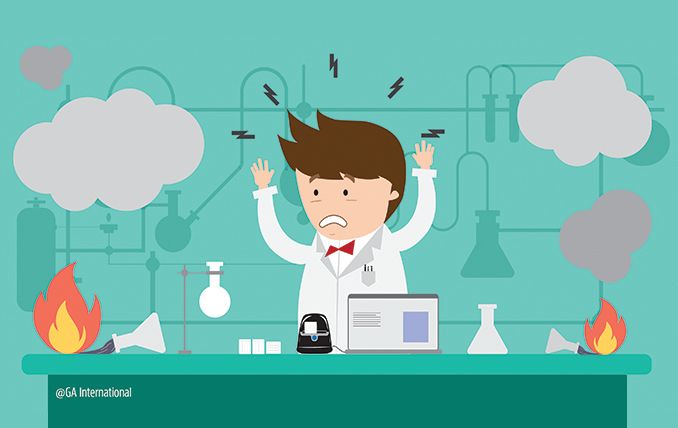
Anyone who’s ever worked in a research lab knows that failure is as inevitable as death or taxes. Imagine having to perform a finicky technique from scratch, without previous experience or the help of anyone well-versed in it either. After the hundredth time—I swear it took a lot more than that to finally get it right—the stress can become difficult to manage and solutions start to feel like a far-off fantasy. Fortunately, there are many things you can do to manage failure in the lab and come back stronger.

So, it’s your first time running an experiment? Doesn’t matter if it's something as straightforward as PCR or as complex as ChIP, you'll need to figure out what you’re doing and the best way to do it. A well-run lab usually has a large dictionary of standard operating procedures (SOPs) for a variety of techniques. But what if your lab doesn’t have a protocol for the technique you require? Here, we’ll review some best practices for developing your own set of SOPs in the lab and how they’ll help you and others in your lab get consistent results.

Climate change is a global phenomenon with wide-ranging and potentially disastrous effects for the entire human population. The consumption of fossil fuels (e.g. coal, oil, and gas) combined with mass deforestation has led to exorbitantly high atmospheric CO2 levels that were only last recorded 800,000 years ago. These high CO2 levels have resulted in a significant increase in the average global temperature, a key factor that has led to the polar ice caps melting at an accelerated pace, making the seas warmer and sea levels higher.1 Heat waves are much stronger than they used to be, record-breaking hurricanes occur much more frequently than before, and we’ve lost nearly 60% of the world’s wildlife.2 It’s been well-documented that these changes are a result of human activities, as worldwide economic and technological progress has led to a consistent increase in the amount of CO2 in the atmosphere. Altogether, this has led to a rise in the average global temperature of nearly one degree Celsius since 1901, with the rate of global warming having doubled since 1975.3
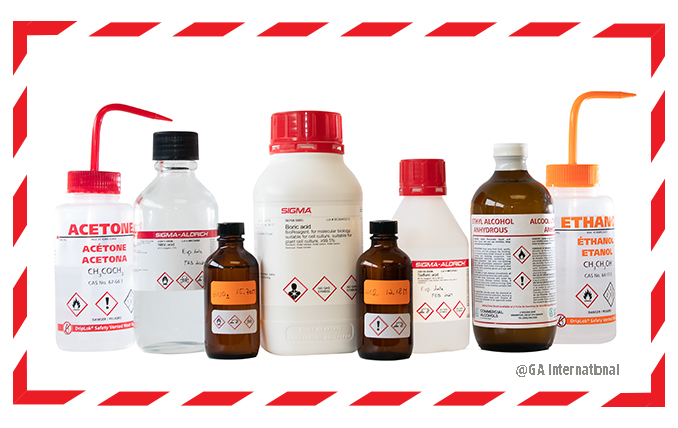
Developed by the United Nations, the Globally Harmonized System of Classification and Labeling of Chemicals (GHS) is a system of classifying the health, physical, and environmental hazards of chemicals to better maintain health and safety standards at the workplace. With so many countries utilizing different chemical classification systems, the GHS was implemented with the goal of having one unified system that would better promote worldwide regulatory efficiency.

Sample identification is critical to running a successful lab. However, there are a host of chemical substances that can ruin your labels, and by extension your experiments. We go over some of the most common of these compounds and how to keep them in check.

Many industries require barcodes to track their inventory, samples, and equipment. To integrate the data from the barcodes into a tracking system, the barcodes must be scanned when each item is processed. So, how do scanners relay the information from barcodes to a computer?

Barcodes are used worldwide as one of the most efficient means of tracking packages and containers. However, the use of barcodes is not solely limited to labels. Living organisms can also be barcoded genetically, allowing individual cells to be monitored and tracked.

Valentine’s day is a special day for couples around the world. For those who believe that love is blind, it doesn’t really matter how or why they love their significant other; they simply love them because of who they are, no matter what (unless they leave the toilet seat up, then things get a little hairy). For scientists, though, studying love represents an intriguing challenge, from both evolutionary and biochemical perspectives. By studying humans and other monogamous animals—the prairie vole, in particular—researchers have devised biological theories that explain the reasons behind why we love and how our bodies react to affection and desire.

Histology has evolved considerably since its beginnings in the 17th century, with advances in both specimen processing and analysis. Consequently, histology departments now face increasingly larger workloads. To adapt, they have integrated automated systems, which save time and allow histology professionals to work on other skill-based tasks, while maintaining enough flexibility to process and stain according to the needs of the medical or research lab. Here, we’ll explore how automation has been integrated into histology to speed up the workflow of both medical technicians and researchers.

Whether you have banks of cell lines stored in liquid nitrogen or assay reagents constantly consumed, managing your inventory is necessary to keep your lab running smoothly. That means having processes and workflows in place to guarantee the lab is working at peak efficiency, as well as having the proper material and infrastructure to track and manage your assets. Below, we’ll discuss some of the ways you can efficiently manage your inventory and keep track of everything in your lab.